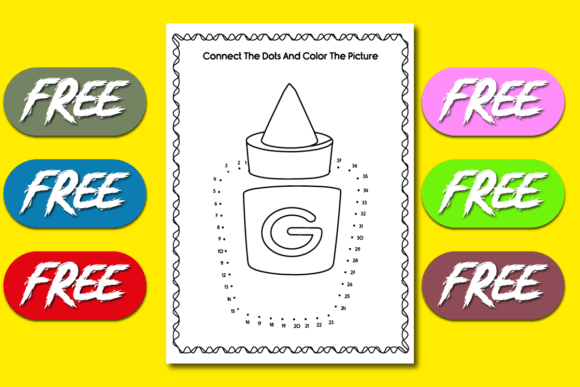
Connect the Dots Dot to Dot 1 to 37: A Strategic Learning Tool for Modern Educators and Creative Professionals
In today’s rapidly evolving educational and creative landscape, professionals across early childhood education, curriculum design, freelance content creation, and edtech development are re-evaluating how foundational numeracy tools intersect with engagement, adaptability, and scalability. At the center of this shift is a deceptively simple yet highly versatile resource: Connect the Dots Dot to Dot 1 to 37. More than just a printable activity, it represents a convergence of pedagogical intention, design flexibility, and cross-generational utility — all packaged in a single, fully editable 8.5 x 11-inch PDF file.
A Precision-Crafted Bridge Between Skill Development and Creative Expression
The Connect the Dots Dot to Dot 1 to 37 worksheet is intentionally sequenced from 1 through 37 — a range that extends meaningfully beyond standard 1–20 or 1–30 formats used in most preschool counting resources. This deliberate expansion supports emerging cognitive milestones: children aged 4–5 begin transitioning from rote counting to understanding number magnitude, sequencing logic, and one-to-one correspondence across larger sets. For educators and curriculum designers, this makes the file not just a filler activity but a scaffolded learning instrument — one that aligns with NCTM (National Council of Teachers of Mathematics) early learning guidelines and state-aligned kindergarten readiness standards.
What distinguishes this resource from generic dot-to-dot offerings is its integrated functionality. It serves simultaneously as:
- A counting worksheet reinforcing sequential fluency,
- A number recognition game for preschoolers, where visual discrimination strengthens symbol–quantity association,
- A tracing worksheet for kindergarten ages 2–4, supporting fine motor development and pre-writing muscle memory,
- A puzzle activity workbook for kids and adults, offering low-stakes cognitive challenge for intergenerational or therapeutic use,
- And a coloring book for children ages 3–5, where completion triggers intrinsic reward through visual transformation — turning abstract numbers into tangible, joyful imagery.
This multi-layered design reflects a broader industry trend: the move away from siloed skill-building toward convergent learning experiences. In classrooms and home learning environments alike, time is scarce and attention spans are fragmented. Resources that layer numeracy, motor control, creativity, and emotional payoff in one coherent flow are no longer “nice to have” — they’re operationally essential.
Why Professionals Are Prioritizing Editable, High-Fidelity Assets
The fact that this Connect the Dots Dot to Dot 1 to 37 file is fully editable in Adobe Illustrator (AI) signals a deeper strategic advantage — one resonating strongly with creators, entrepreneurs, and instructional designers. Unlike raster-based PNGs or locked PDFs, an AI-editable vector file allows for immediate customization: adjusting dot size for learners with visual processing needs, modifying line weight for tracing clarity, inserting custom fonts for bilingual instruction, or repositioning elements to accommodate IEP accommodations. This level of control transforms a static worksheet into a living component of differentiated instruction.
For freelancers building digital product suites — think Teachers Pay Teachers sellers, Montessori-aligned content creators, or homeschool curriculum developers — editable assets accelerate iteration cycles. A single AI file can spawn multiple derivatives: simplified versions (1–20), advanced extensions (1–50 with skip-counting cues), thematic variants (Back to School Connect the Dots Count to 37), or even branded versions for private academies or learning apps. That scalability directly impacts revenue potential and client retention — especially as schools and families increasingly demand personalized, adaptable learning materials.
Aligning With Consumer and Cultural Shifts
Parents, caregivers, and early educators are no longer satisfied with “busy work.” They seek activities grounded in evidence, aligned with developmental science, and rich in secondary benefits — like emotional regulation through coloring or language development via guided naming of completed images. The Dot to Dot and Color the Picture format embedded in this resource meets that expectation precisely. When a child connects dots 1 to 37 and reveals a school bus, apple, or backpack, the moment becomes a springboard for vocabulary building, narrative play, and contextualized math talk (“How many wheels does the bus have? Let’s count together.”).
This mirrors a wider consumer trend: the rise of intentional screen-adjacent analog tools. As families navigate digital fatigue and seek balanced media diets, high-quality physical worksheets — especially those designed for tactile interaction and collaborative completion — are experiencing renewed demand. The Back To School Dot to Dot Worksheets variant, for instance, isn’t just seasonal decoration; it functions as a low-pressure transition ritual, helping children emotionally anchor to new routines while quietly reinforcing academic continuity.
Technology as Enabler — Not Replacement
It’s worth noting that the editable AI format doesn’t signal a push toward digitization alone. Rather, it empowers hybrid workflows. Educators print optimized versions for hands-on classroom use. Instructional coaches annotate layers digitally for teacher training modules. App developers extract SVG paths for interactive web-based implementations. Even occupational therapists use the base file to add sensory overlays (e.g., textured dot patterns or weighted line guides). The technology here serves human-centered goals — enhancing fidelity, accessibility, and reuse without compromising the embodied learning that makes early math stick.
Real-World Applications Across Professional Contexts
Consider these practical examples:
- Edtech Startups: Integrate the vector paths into adaptive learning platforms where dot sequence adjusts dynamically based on real-time performance — e.g., slowing at #27 if response latency increases, then scaffolding with audio prompts.
- Freelance Designers: Bundle the AI file with complementary assets (number flashcards, editable lesson plans, progress trackers) to create premium-tier “Back to School Math Kits” priced 3× higher than standalone printables.
- Public School Districts: Use the editable file to localize content — replacing generic illustrations with culturally relevant icons (e.g., community gardens, local landmarks) while retaining pedagogical integrity.
- Therapy Practices: Layer the base artwork with OT-developed handwriting guides or AAC symbol integration, transforming it into a clinical tool for neurodiverse learners.
Each application leverages the same foundational asset — Connect the Dots Dot to Dot 1 to 37 — but tailors it to distinct professional needs, audiences, and outcomes. That versatility is rare. And it’s why forward-looking professionals aren’t just downloading this file — they’re building systems around it.
Looking Ahead: From Worksheet to Workflow Anchor
As learning ecosystems grow more complex — blending AI tutors, micro-credentials, project-based assessment, and family-facing dashboards — the value of well-designed, modular, research-informed foundational tools only increases. The Connect the Dots Dot to Dot 1 to 37 resource exemplifies what’s next: not flashy innovation for its own sake, but quiet, scalable excellence rooted in developmental science and creator pragmatism.
Its 8.5 x 11-inch page size ensures compatibility with standard printers, laminators, and binders — removing friction from implementation. Its focus on numbers 1 to 37 avoids overwhelming young learners while offering enough stretch to sustain engagement across multiple sessions. And its dual identity — as both math numbers practice and puzzle game for kids — reflects a fundamental truth about effective learning: when rigor and delight coexist, retention follows naturally.
For professionals who understand that impact lives at the intersection of insight and execution, this isn’t just another dot-to-dot. It’s a strategic node — connecting pedagogy to design, classroom needs to market demand, and individual growth to systemic readiness. Whether you’re developing your next digital course, launching a preschool subscription box, or redesigning a district’s kindergarten onboarding toolkit, Connect the Dots Dot to Dot 1 to 37 offers a proven, flexible, and deeply human starting point.