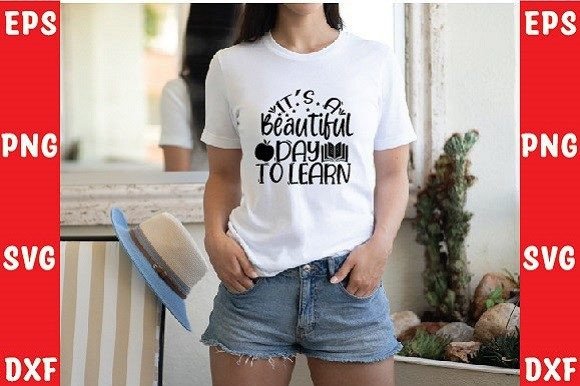
It’s a Beautiful Day to Learn SVG Design: A Practical Guide for Back-to-School Creativity
As summer winds down and classrooms begin to hum with anticipation, educators, crafters, small business owners, and lifelong learners alike are turning their attention to fresh tools that spark engagement and simplify design workflows. It’s a Beautiful Day to Learn SVG Design isn’t just a cheerful phrase—it’s an invitation to embrace scalable vector graphics as a foundational skill for back-to-school season and beyond. Whether you're preparing classroom decorations, launching a student-led merchandise project, or building a custom learning resource library, SVG files offer unmatched flexibility, precision, and adaptability.
Why SVG Is the Backbone of Modern Back-to-School Design
Unlike raster images (such as JPEGs or standard PNGs), SVG—Scalable Vector Graphics—is built from mathematical paths, points, and curves. This means every element retains crisp clarity at any size: whether scaled to fit a tiny badge on a name tag or enlarged across a 48-inch bulletin board. For back-to-school applications—from printable flashcards to vinyl-cut welcome signs—this scalability eliminates pixelation, blurry edges, and time-consuming reformatting.
SVG files also support embedded styling and interactivity (when used in web contexts), but even in static design environments—like Cricut Design Space, Silhouette Studio, or Adobe Illustrator—their layered structure allows for intuitive editing. You can isolate individual letters in a monogram, recolor one shape without affecting another, or adjust stroke weights independently. That level of control is essential when tailoring designs for diverse learning needs: high-contrast versions for visual accessibility, simplified outlines for younger students’ tracing activities, or color-coded elements for multisensory instruction.
What’s Inside the “It’s a Beautiful Day to Learn SVG Design” Package
The downloadable zip file dated 15 Aug 2022 delivers a thoughtfully curated set of production-ready assets designed for real-world versatility:
- 1 SVG file: Fully layered, grouped, and named—ideal for digital cutting machines, web integration, or further vector refinement.
- 1 PNG file: High-resolution (300 DPI), transparent-background raster version—perfect for digital presentations, Google Slides templates, or print-on-demand platforms that don’t accept vector uploads.
- 1 EPS file: Encapsulated PostScript format, compatible with legacy professional print workflows and widely supported by commercial printers for offset or large-format output.
- 1 DXF file: AutoCAD-derived format optimized for CNC routers, laser engravers, and certain industrial cutting systems—enabling precise physical fabrication in wood, acrylic, or metal.
- 100% vector integrity: Every curve, corner, and contour is mathematically defined—not traced or rasterized—ensuring smooth scaling and clean path manipulation.
This multi-format approach reflects how modern creators operate across ecosystems: designing once, deploying everywhere. A teacher might use the SVG in Canva to build a classroom welcome banner; a parent entrepreneur could import the DXF into LightBurn to cut personalized backpack tags; a school communications officer might drop the EPS into InDesign for a polished newsletter header.
Real-World Applications Across Learning Environments
The strength of It’s a Beautiful Day to Learn SVG Design lies not in its technical specs alone—but in how seamlessly it integrates into daily educational and creative practice.
Classroom & Curriculum Support
Educators use these files to create tactile, reusable learning tools. The “Back to School” motif—often featuring apples, pencils, open books, or sun-dappled chalkboards—can be resized to fit pocket charts, laminated word walls, or interactive whiteboard drag-and-drop activities. Because the vectors are easy to recolor, teachers can quickly generate versions aligned with school colors, seasonal themes (e.g., autumn leaves or winter mittens), or inclusive representation (adjusting skin tones in illustrated figures via fill swatches).
Student-Led Projects & Digital Literacy
Introducing SVG fundamentals supports computational thinking: students learn about layers, grouping, anchor points, and coordinate systems—not abstractly, but through hands-on creation. With tools like Vectr, Inkscape (free and open-source), or browser-based editors, learners can modify the provided files—changing fonts, adding initials, or animating simple transitions—building confidence in both design logic and digital fluency. This bridges art, technology, and language arts in authentic, standards-aligned ways.
Small Business & Community Use
Local tutoring centers, after-school programs, and PTA groups often need branded materials on tight budgets and timelines. These SVG assets let them produce cohesive identity kits—matching tote bags, water bottles, and event signage—without hiring a designer for every variation. A single file becomes the source of consistency across social media banners (PNG), embroidered patches (SVG + embroidery software), and storefront decals (DXF for vinyl cutters). The ease of resizing ensures no layout compromises—whether printing on a 3x5 inch sticker or a 6x8 foot window graphic.
Workflow Advantages You’ll Notice Immediately
Adopting It’s a Beautiful Day to Learn SVG Design streamlines common bottlenecks:
- No more manual resizing headaches: Resize without distortion—even to non-standard proportions—and maintain proportional spacing between text and icons.
- Effortless color customization: Fill and stroke properties update instantly across all instances of a selected object. Swap palettes in seconds for A/B testing, accessibility compliance, or brand alignment.
- Non-destructive editing: Grouping and layer naming preserve design intent. You’re never forced to “ungroup and recombine” just to move one element.
- Cross-platform compatibility: Open the same SVG in Affinity Designer, Figma, CorelDRAW, or even Microsoft PowerPoint (with recent updates)—and retain editable structure.
This reliability matters most when deadlines loom: imagine finalizing a batch of 30 personalized graduation certificates the night before distribution—or generating alternate versions of a reading log chart for differentiated instruction—all from one master file.
Design Integrity Meets Educational Intent
What sets this collection apart isn’t just format diversity—it’s intentional craftsmanship. Each path is simplified to reduce node count without sacrificing detail, ensuring fast rendering in web browsers and stable performance in cutting software. Text is converted to outlines (not live fonts), eliminating missing-font errors across devices. And unlike many free downloads cluttered with hidden layers or embedded raster images, these files follow vector best practices: clean anchors, consistent stroke alignment, and logical grouping hierarchy.
That attention extends to usability. For example, the apple icon in the “Back to School” set includes separate layers for stem, leaf, shine, and bite mark—so a special education teacher can hide the bite for sensory-sensitive learners, or a kindergarten teacher can lock the stem while letting students drag-and-drop only the leaf during a science lesson on plant parts.
Getting Started Without Overwhelm
If you’re new to SVG, start small. Import the file into a free tool like Inkscape or Vectr. Try these beginner-friendly actions:
- Select a single shape (e.g., a pencil outline) and change its fill color using the palette bar.
- Use the “Ungroup” command once—then try moving just the eraser tip while leaving the rest intact.
- Export a new PNG at 1500px width for a handout, then export the same selection as SVG for a digital worksheet.
Each step reinforces core concepts: objects vs. groups, fill vs. stroke, resolution independence. There’s no need to master Bezier curves on day one—just notice how your edits persist cleanly, no matter how many times you resize or re-export.
Long-Term Value Beyond Back-to-School
While timed for August relevance, It’s a Beautiful Day to Learn SVG Design offers enduring utility. The same file that decorates a “Welcome Back” door display can evolve into a “Science Fair Winner” ribbon, a “Library Card Holder” template, or a “Growth Mindset Journal Cover.” Because vectors aren’t tied to fixed dimensions or pixel grids, they grow with your needs—supporting curriculum updates, facility renovations, or shifts in pedagogical focus.
Moreover, familiarity with SVG builds transferable literacy. Understanding how vector files function demystifies digital production pipelines—from website development (where SVG icons load faster than icon fonts) to 3D modeling (where vector paths extrude into physical forms). It’s a quiet but powerful foundation for future-ready skills.
Final Thought: Design as an Act of Care
At its heart, It’s a Beautiful Day to Learn SVG Design reflects a deeper truth: thoughtful design communicates respect—for learners’ time, for educators’ expertise, and for the varied ways people engage with knowledge. When a worksheet loads instantly on a low-bandwidth tablet, when a tactile sign withstands repeated handling in a busy hallway, when a student sees their name rendered precisely on a certificate—they feel seen. That’s the quiet power of well-crafted, accessible, versatile vector design. And it begins, simply, with choosing the right file—and knowing exactly what to do with it.