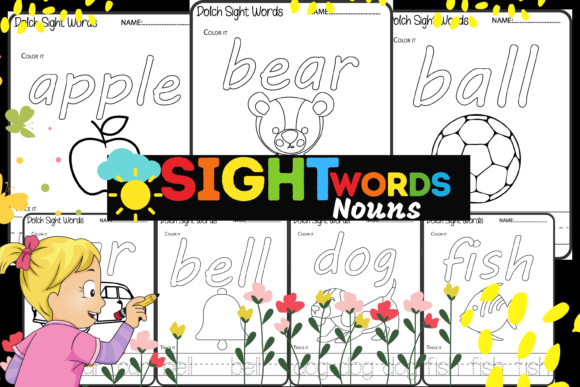
Color and Learn Sight Words: Building Confidence Through Playful Literacy
For young readers, mastering sight words is more than memorization—it’s a foundational leap toward reading fluency, comprehension, and self-assurance. Color and Learn Sight Words transforms this essential learning milestone into an engaging, multisensory experience—blending visual recognition, fine motor development, and joyful creativity in one cohesive resource.
Why Sight Words Matter—and Why They’re Best Learned Early
Sight words are high-frequency nouns, verbs, and function words that appear constantly in early texts—words like “school,” “book,” “desk,” and “teacher.” Because many don’t follow standard phonetic patterns (e.g., “said” or “was”), they’re most effectively internalized through repeated exposure and meaningful context—not just decoding.
Research consistently shows that children who confidently recognize 20–30 core sight words by the end of pre-K read with greater fluency and express stronger motivation to tackle new books. That confidence isn’t abstract—it shows up in raised hands during circle time, in independent story retelling, and in the quiet pride of finishing a leveled reader without prompting.
The 11 Back-to-School Sight Word Nouns: Purposefully Curated
This Color and Learn Sight Words volume centers on 11 thematic, school-related nouns ideal for pre-K through 3rd grade learners:
- Book
- Desk
- Teacher
- Student
- Backpack
- Classroom
- Chalkboard
- Lunchbox
- Homework
- Recess
- School
Each word was selected not only for frequency in early readers but also for its strong visual association—making it especially effective when paired with illustration and color. A child coloring a detailed “backpack” while tracing the word reinforces spelling, meaning, and usage all at once.
What Makes These Pages Different? Design With Intention
Unlike generic coloring sheets, the Color and Learn Sight Words collection is built around pedagogical intentionality and practical usability:
- Large 8.5 × 11 inch format—optimized for little hands and classroom printing, with generous white space for grip and control.
- Thick, dark outlines—supporting pencil control, marker stability, and early scissor practice without frustration.
- Festive, inclusive illustrations—featuring diverse students, accessible classrooms, and joyful, relatable back-to-school moments.
- High-resolution JPGs + print-ready PDFs—ensuring crisp rendering whether used digitally on tablets, printed for centers, or scaled for bulletin boards.
Every page invites interaction: trace the letters, say the word aloud, identify the object in the picture, then color thoughtfully—building neural pathways across language, motor, and visual processing systems simultaneously.
Real-World Uses Across Learning Environments
This resource thrives beyond the worksheet bin. Here’s how educators, caregivers, and creators apply it meaningfully:
In the Classroom
Teachers use individual pages as morning warm-ups, literacy center rotations, or differentiated take-home practice. The “chalkboard” page doubles as a vocabulary anchor chart; the “recess” sheet sparks descriptive writing prompts (“What do you hear, see, and feel at recess?”).
At Home
Parents appreciate how quickly these pages shift “practice” from chore to connection. A five-minute coloring session becomes shared storytelling—“What’s in *your* backpack?”—naturally reinforcing word meaning and usage in authentic conversation.
In Therapy & Intervention
Speech-language pathologists and occupational therapists integrate the pages into sessions targeting articulation (e.g., practicing /b/ in “backpack”), vocabulary expansion, and bilateral coordination—all while keeping engagement high.
For Creators & KDP Publishers
Designed and tested specifically for Amazon Kindle Direct Publishing, the full package includes 11 ready-to-upload JPGs and a polished 11-page PDF—no formatting surprises, no pixelation, no copyright concerns. It fits seamlessly into activity book bundles, handwriting workbooks, or themed “Back to School” collections—and performs well because it solves real problems: low prep time, high kid appeal, and measurable literacy alignment.
Strengths—and Honest Considerations
Color and Learn Sight Words excels where many resources fall short: it meets developmental needs without oversimplifying. Its strength lies in balance—structured enough to support learning goals, flexible enough to adapt to varied pacing and interests.
That said, it’s important to understand what it is—and isn’t:
- It’s not a stand-alone curriculum. It works best alongside read-alouds, guided writing, and phonics instruction—not in isolation.
- It assumes basic letter familiarity. While great for reinforcement, it’s less suited for absolute beginners still distinguishing letter shapes.
- It prioritizes nouns first. This volume focuses on concrete, image-friendly words—ideal for visual learners and English language learners—but doesn’t cover pronouns, prepositions, or irregular verbs (those appear in future volumes).
Used thoughtfully, it’s a catalyst—not a replacement—for rich language experiences.
Who Benefits Most—and How to Choose Wisely
This resource serves three primary audiences exceptionally well:
- Early childhood educators seeking low-prep, standards-aligned materials that honor play-based learning.
- Parents and homeschoolers looking for screen-free, portable activities that grow with their child—from tracing with a finger to independent coloring and sentence-building.
- KDP creators building niche educational products with clear utility, strong search visibility (“sight words coloring pages,” “Dolch nouns PDF”), and proven market resonance.
If your goal is to strengthen word recognition *through doing*, not just drilling—if you value clarity over clutter and evidence-informed design over trend-chasing—then Color and Learn Sight Words delivers tangible, classroom-tested value.
A Final Thought: Confidence Grows in Color
There’s something quietly powerful about watching a child sound out “l-u-n-c-h-b-o-x,” then pause, point to the lunchbox they’ve just colored red and yellow, and declare, “That’s *mine*.” In that moment, the word stops being abstract. It becomes owned.
Color and Learn Sight Words nurtures that ownership—not through pressure, but through permission to explore, create, and connect. It reminds us that literacy begins not with perfection, but with presence: the presence of a caring adult, the presence of joyful repetition, and the presence of color filling the lines of a word—and, slowly, a confident young reader’s world.