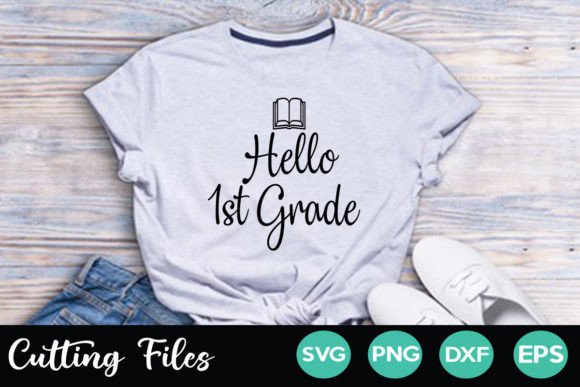
Hello 1st Grade: Back-to-School SVG Bundle
Starting first grade is a milestone—not just for children, but for everyone who supports them. Teachers preparing classroom displays, parents crafting personalized welcome gifts, small business owners stocking seasonal merchandise, or educators designing inclusive learning materials all face the same quiet challenge: finding design assets that are both meaningful and technically reliable. That’s where Hello 1st Grade stands out—not as generic clipart, but as a purpose-built digital resource crafted for real-world use across multiple platforms and projects.
Why Format Flexibility Matters More Than You Think
A single design idea shouldn’t require re-creating files every time you switch tools. The Hello 1st Grade bundle delivers four distinct file types—SVG, PNG, EPS, and DXF—in one ZIP download. Each serves a specific technical need without forcing workarounds.
- The SVG file works natively with Cricut Design Space, Silhouette Studio Designer Edition, and other web-based cutting platforms—ideal when precision matters, like cutting vinyl for classroom name tags or iron-on transfers for student T-shirts.
- The PNG file includes a transparent background, making it ready for immediate use in Canva, Google Slides, or Microsoft PowerPoint—no extra editing needed to overlay text or place on themed backgrounds for digital newsletters or printable reward charts.
- The EPS file ensures full scalability and editability inside Adobe Illustrator or CorelDRAW—useful if you’re adapting the design for school-branded signage, custom lesson handouts, or high-resolution print jobs like posters or banners.
- The DXF file is compatible even with Silhouette Studio’s free version—so hobbyists, homeschoolers, or budget-conscious teachers can cut cleanly without upgrading software.
This isn’t about having “more files.” It’s about eliminating friction. When you’re juggling lesson planning, supply ordering, and parent communication, spending 20 minutes converting formats—or discovering mid-project that your chosen file won’t scale without pixelation—is avoidable. With Hello 1st Grade, you open the ZIP and start creating.
Real Use Cases—Not Just Possibilities
Consider a few grounded examples:
- A public school art teacher uses the SVG to cut adhesive letters from matte vinyl, then applies them to cubbies labeled “Ella,” “Mateo,” and “Jamal”—each with the Hello 1st Grade phrase beneath. The clean vector edges hold up after months of hallway traffic and repeated cleaning.
- A freelance designer building a back-to-school product line for Etsy imports the EPS into Illustrator, adjusts spacing and font weight to match their brand guidelines, then exports variations for mugs, tote bags, and enamel pins—all while preserving vector integrity.
- A homeschool parent opens the PNG in Google Docs, drops it into a weekly schedule template, adds checkboxes and color-coded subjects, and prints a laminated version for their child’s desk—no software installation, no trial-and-error cropping.
- A PTA volunteer creates a welcome banner using the DXF file in Silhouette Studio, cuts it from corrugated plastic, and mounts it outside the school entrance—visible, weather-resistant, and legible from 15 feet away.
Each scenario reflects how format choice directly affects outcome quality, time investment, and accessibility—not theoretical advantages, but measurable differences in execution.
Who Benefits Most—and Why Timing Matters
Hello 1st Grade is especially valuable for professionals and creators whose work intersects with early education transitions. That includes elementary teachers (both general and special education), curriculum designers, school communications staff, small-batch apparel printers, educational content creators, and parent-led enrichment coordinators.
Its relevance peaks during late July through early September—but its utility extends beyond the calendar. Because these are digital files, they’re reusable year after year. A teacher who downloads Hello 1st Grade this summer can archive the ZIP, reopen it next August, and adapt the same core design for new students, updated standards, or revised classroom themes—without repurchasing or searching again.
That said, it’s not a universal solution. If your workflow relies exclusively on Procreate, Affinity Designer, or Figma—and you don’t export or import vector assets—you’ll likely need to convert or trace the files externally. Similarly, while the PNG is high-resolution, it’s not intended for billboard-scale printing; for large-format outdoor signage, the EPS or SVG remains the better starting point.
Practical Integration Tips
Before diving in, consider how Hello 1st Grade fits into your existing toolkit:
- Check your software version. Some older versions of Silhouette Studio require the DXF format for basic cutting functions—even if you own the software, confirm compatibility before assuming SVG will load.
- Test cut or print at 10% scale first. Especially with intricate letterforms or thin dividers, verifying material feed, blade depth, or ink coverage saves time and materials.
- Use the PNG for fast social media graphics. Resize it in Canva or Adobe Express, pair it with a short caption (“First day jitters? We’ve got you.”), and post to Instagram or Facebook—no licensing concerns, no attribution required.
- Modify thoughtfully. The EPS and SVG retain layered elements, so you can isolate the “Hello” text from the “1st Grade” subline or recolor individual components—ideal for aligning with school colors or accessibility needs like contrast adjustments.
These aren’t instructions baked into the file—they’re observations drawn from real usage patterns among educators and makers who rely on consistent, adaptable assets rather than one-off visuals.
Digital-Only Delivery: What It Means for You
You’ll receive a ZIP file via email immediately after purchase—no waiting for shipping, no tracking numbers, no customs delays. There are no physical products, which means no inventory management if you're reselling, no storage space needed if you're collecting resources, and no environmental footprint from packaging or transit.
This model also supports iterative improvement. Because updates—like adding bilingual versions or alternate fonts—can be distributed digitally, users benefit from future enhancements without repurchasing. That kind of long-term support is rare in standalone design assets, yet increasingly expected by professionals who treat creative resources as infrastructure, not decoration.
Ultimately, Hello 1st Grade succeeds not because it’s “cute” or “trendy,” but because it removes predictable pain points: incompatible formats, inconsistent scaling, unclear licensing, and fragmented sourcing. It meets a specific moment—first grade orientation—with tools calibrated for clarity, flexibility, and reuse. Whether you’re prepping a single child’s backpack tag or launching a district-wide welcome campaign, the value lies in what you don’t have to do—so you can focus on what truly matters.