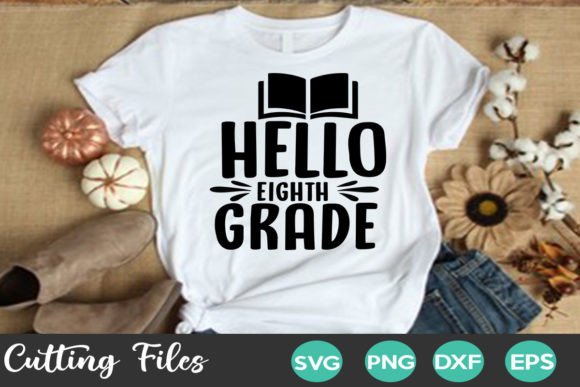
Hello Eighth Grade: A Digital Back-to-School Design Asset for Real-World Workflow Integration
“Hello Eighth Grade” isn’t just a nostalgic phrase—it’s a ready-to-deploy digital design asset built for creators who value precision, flexibility, and speed. Designed with educators, small business owners, craft entrepreneurs, and content producers in mind, this file set bridges the gap between conceptual planning and tangible output—whether you’re prepping classroom decor, launching a seasonal merch line, or building branded learning materials.
What You Receive—and Why Format Diversity Matters
The deliverable is a single ZIP file containing four distinct file types: SVG, PNG, EPS, and DXF. Each serves a specific role in different stages of your workflow—and their coexistence eliminates format-switching friction.
- SVG: Optimized for Cricut Design Space, Silhouette Studio Designer Edition, and other web-based cutting platforms. Use it when precision vector cutting is required—think iron-on transfers for student welcome shirts or vinyl wall decals for a middle school hallway display.
- PNG: High-resolution with transparent background. Ideal for immediate use in Canva, Google Slides, PowerPoint, or Adobe Express—no tracing or background removal needed. Drop it into lesson plans, email newsletters, or social media banners without editing overhead.
- EPS: Industry-standard vector format compatible with Adobe Illustrator and CorelDRAW. Essential if you’re scaling the design for large-format printing (e.g., posters, banners) or integrating it into layered branding assets like style guides or marketing collateral.
- DXF: The universal language for basic Silhouette Studio users—including the free version. Ensures accessibility across team members or collaborators who don’t subscribe to premium software tiers but still need clean cut paths.
This multi-format structure supports parallel workflows: while one person prepares a T-shirt order using the SVG in Cricut, another builds a printable welcome packet using the PNG in Word, and a third exports a scaled EPS for a district-wide newsletter header—all from the same source file.
Where “Hello Eighth Grade” Fits in Your Planning Cycle
Unlike generic clipart, this asset functions best when embedded early—not as an afterthought, but as a planning lever.
Before a project: Use the PNG version during stakeholder alignment. Paste it into a shared brief or mood board to visually confirm tone and audience fit before investing time in layout or production. Its clear typography and age-appropriate energy signal “middle school readiness” without ambiguity—reducing revision rounds later.
During execution: Leverage the SVG and DXF files in tandem when batch-producing physical items. For example, a homeschool co-op organizing orientation kits might load the SVG into Cricut to cut vinyl name tags, then use the DXF in Silhouette Studio to cut matching cardboard folder labels—ensuring consistent sizing and spacing across two machines and two material types.
After launch: Repurpose the EPS into editable templates for future years. Rename layers, swap colors to match new school branding, or combine it with updated photography—all within Illustrator. This transforms a one-time purchase into a reusable component of your institutional or business design system.
Compatibility That Supports Real Team Dynamics
Teams rarely run on uniform software. A teacher may use Canva; a PTA volunteer prefers Silhouette; a local print shop works exclusively in Illustrator. “Hello Eighth Grade” anticipates that reality. Its format suite avoids vendor lock-in and reduces dependency on workarounds like screenshotting, manual tracing, or third-party converters—each of which introduces quality loss or version drift.
More importantly, the files are pre-optimized: strokes are outlined, text is converted to paths, and grouping is logical—not nested unnecessarily. That means less time troubleshooting missing fonts or misaligned layers, and more time focusing on messaging, placement, and audience impact.
Practical Implementation Tips for Consistent Results
Organize by use case, not format. Create folders named “Cutting Files,” “Print & Digital,” and “Brand Assets”—then place copies of the relevant files inside each. This mirrors how you’ll actually access them, not how they were delivered.
Test before scaling. Run a single test cut on scrap material—even if you’ve used the file before. Machine calibration, blade wear, and material thickness vary. Likewise, open the PNG in your intended editor and verify transparency renders correctly before exporting final PDFs.
Preserve original files. Never edit the master SVG or EPS directly. Duplicate and rename before adjusting colors or proportions. That way, you retain a clean source for future iterations—critical if your school updates its color palette or your brand evolves.
Leverage layer logic. In Illustrator or Silhouette Studio, check whether elements (e.g., “Hello,” “Eighth Grade,” decorative underline) exist on separate layers. If so, you can isolate parts for different applications—like using only the “Eighth Grade” portion on student ID badges while keeping the full phrase for wall signage.
Long-Term Utility Beyond the First Week of School
This isn’t a seasonal prop—it’s a foundational element for recurring communication cycles. Eighth grade marks a transition point: students move from elementary routines to adolescent expectations. That makes “Hello Eighth Grade” especially useful for scaffolding initiatives across the academic year.
Use it to anchor sequences: “Hello Eighth Grade” (orientation), “Hello Eighth Grade—Science Edition” (lab safety signage), “Hello Eighth Grade—Leadership Track” (student council materials). With minor text edits in Illustrator or layer visibility toggles in Silhouette, you maintain visual continuity while signaling thematic shifts.
For small businesses serving schools—custom apparel shops, educational consultants, curriculum designers—this file becomes part of a repeatable client onboarding kit. Pair it with editable lesson plan templates or editable permission slip layouts, and you reduce setup time per school by 30–50%.
Quality Control Starts With File Integrity
Because these files are digital and non-physical, quality assurance happens upstream—in how you handle, store, and deploy them. Verify checksums if provided (some sellers include MD5 or SHA-256 hashes), and keep backups in at least two locations: local drive + cloud storage with version history enabled.
When sharing with collaborators, send the ZIP—not individual files—and include a brief README.txt noting recommended software versions (e.g., “Cricut Design Space v7.0+,” “Silhouette Studio 4.4+”) and known compatibility notes. This prevents someone from opening an EPS in an outdated Illustrator version and assuming the file is corrupted.
Final Thought: Design Assets Are Workflow Infrastructure
“Hello Eighth Grade” earns its place not because it’s decorative—but because it integrates cleanly into planning, production, and iteration loops. It reduces cognitive load at decision points (“Which file do I need?”), shortens handoff delays (“Can you send me the vector?”), and maintains consistency across outputs that serve different audiences—students, parents, staff, vendors.
That’s the mark of infrastructure-grade digital assets: they don’t draw attention to themselves. Instead, they make the work behind the scenes faster, more reliable, and easier to replicate—exactly what professionals need when managing real deadlines, real teams, and real outcomes.