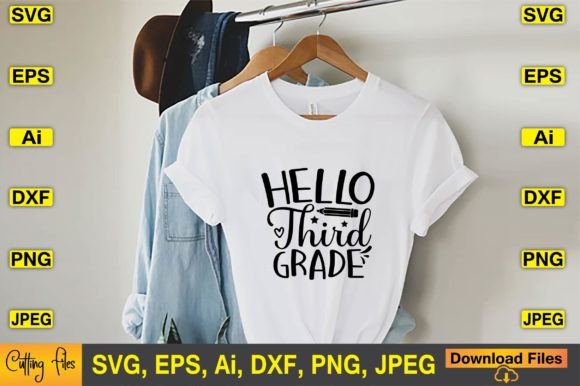
Hello Third Grade SVG T-shirt Design: A Versatile Digital Asset for Educators, Makers, and Small Businesses
Designing for milestones—whether academic, developmental, or celebratory—requires both authenticity and adaptability. The Hello Third Grade SVG T-shirt Design exemplifies this balance: a thoughtfully crafted digital asset that bridges pedagogy, personal expression, and production-ready utility. Unlike generic clipart or overused classroom motifs, this design carries intentional visual language—playful yet legible, age-appropriate yet timeless—and is engineered for seamless integration across physical and digital mediums.
Why Format Diversity Matters in Real-World Production
At its core, the Hello Third Grade SVG T-shirt Design isn’t just a graphic—it’s a multi-format toolkit. The ZIP folder delivers six distinct file types: SVG, AI, EPS, DXF, PNG, and JPEG. Each serves a specific technical purpose, and understanding their roles empowers users to avoid costly missteps during fabrication or publishing.
- SVG files are the gold standard for Cricut and Silhouette machines. They preserve vector paths, enabling precise cutting of vinyl, heat transfer material, or iron-on sheets—critical when producing classroom T-shirts, name tags, or bulletin board accents.
- AI and EPS files offer native Adobe Illustrator compatibility, allowing educators or small business owners to modify layers, adjust spacing, or reposition text without raster degradation—ideal for customizing class rosters or aligning with school branding guidelines.
- DXF files ensure interoperability with CNC routers, laser cutters, and certain CAD-based sign-making tools—making the design viable not only for fabric but also for wooden classroom signs, acrylic desk plaques, or foam-core display boards.
- PNG files (4500 × 5400 px, 300 dpi, transparent background) support high-fidelity print use: greeting cards, scrapbook pages, art prints, or digital invitations where resolution and edge clarity directly impact perceived quality.
- JPEG files serve as lightweight previews or web embeds—useful for email newsletters, social media announcements, or quick mockups before committing to full-size printing.
This breadth eliminates format-related bottlenecks. A homeschool parent preparing a “Third Grade Kickoff” tote bag can use the SVG on a Cricut Joy; a PTA coordinator designing a fundraising poster pulls the PNG into Canva; a boutique owner printing mugs via sublimation imports the EPS into Sawgrass Creative Studio—all from the same source package.
Practical Applications Across User Groups
The versatility of the Hello Third Grade SVG T-shirt Design becomes most evident when mapped to real-world workflows—not marketing claims, but observable usage patterns across professions and life stages.
Educators and School Support Staff
Teachers routinely curate materials that reinforce identity and belonging. This design appears frequently in “All About Me” units, third-grade orientation kits, and end-of-year memory books. Its layered SVG structure allows instructors to isolate elements—removing the “Hello” banner while keeping the grade number intact for reusable templates—or recolor individual components to match classroom color coding systems. One elementary art specialist reported using the DXF version to etch the design onto reclaimed wood panels for hallway displays, pairing academic celebration with sustainability messaging.
Crafters and Small-Batch Producers
Hobbyists and micro-businesses benefit from the inclusion of word-by-layer SVG files. These aren’t flattened graphics—they’re segmented so “Hello,” “Third,” and “Grade” function as independent objects. That means adjusting kerning between words, substituting “Third” with “3rd” for minimalist appeal, or applying different textures (e.g., glitter vinyl for “Hello,” matte black for “Grade”) on a single shirt. Vinyl decal sellers report higher conversion rates when offering layered options, as customers perceive greater customization control—even if they ultimately choose the default layout.
Families and Gift-Makers
Parents and caregivers use the design beyond apparel: iron-on transfers for backpacks, printable banners for birthday parties themed around “My First Year as a Third Grader,” or die-cut shapes for handmade cards congratulating a child’s promotion. The transparent-background PNG enables clean compositing over photos—a grandmother might overlay the design onto a portrait of her granddaughter holding her third-grade report card, then print it as a framed keepsake.
Small Businesses and Print-on-Demand Sellers
Entrepreneurs leveraging platforms like Etsy, Redbubble, or Printful rely on production-ready assets. The inclusion of both SVG and high-res PNG files satisfies dual needs: SVG for automated vinyl cutting workflows and PNG for direct-to-garment (DTG) or sublimation uploads where vector interpretation by platform software can introduce inconsistencies. Notably, the 300 dpi resolution meets industry standards for commercial printing up to 18×24 inches—meaning the same file scales cleanly from a baby onesie (3×4 inches) to a large event banner (48×72 inches) without interpolation artifacts.
Design Integrity and Age-Appropriate Considerations
Effective educational graphics avoid infantilization while remaining accessible. The Hello Third Grade SVG T-shirt Design uses rounded, open letterforms with generous x-heights—supporting emerging readers without sacrificing visual maturity. Color-blocking is minimal, prioritizing contrast over complexity, which aids both screen readability and vinyl application accuracy. There are no licensed characters, seasonal clichés (e.g., apples, pencils), or gendered tropes—making it inclusive across diverse classrooms and family structures.
This neutrality extends functionality. A speech-language pathologist used the layered SVG to create interactive articulation cards, assigning different phonemes to each word segment (“Hel-lo,” “Thir-d,” “Gr-ade”) for motor planning practice. A special education team adapted the design into a visual schedule icon, replacing “Hello” with “Today I Am…” to support self-identity narratives.
Implementation Best Practices
To maximize utility, users should adopt consistent naming conventions and version control—even with instant-download files. Renaming “Hello_Third_Grade_SVG.zip” to include date and intended use (e.g., “HTG_TShirt_Vinyl_20240815.zip”) prevents confusion across projects. When importing into design software, always verify layer visibility and grouping status; some programs auto-flatten upon import unless instructed otherwise.
For heat-transfer applications, mirror the design before cutting—but only if using printable HTV. For cut-only vinyl, mirroring occurs automatically in machine software. Test cuts on scrap material first, especially when combining multiple vinyl types (e.g., holographic + matte) within one layout—the layered SVG makes such experiments low-risk and iterative.
Scalability Beyond the Obvious
While T-shirts and totes are common entry points, the design’s architecture supports less intuitive applications. A community library repurposed the SVG into a QR-code-integrated floor decal: the “Third Grade” text formed the border of a scannable square linking to summer reading resources. A university teacher-prep program embedded the PNG into an augmented reality (AR) marker, triggering a short video of third-grade students explaining math concepts when viewed through a mobile device.
Even data visualization benefits indirectly: researchers studying literacy development have used the layered structure to map concept acquisition timelines—assigning “Hello” to initial exposure, “Third” to skill consolidation, and “Grade” to mastery demonstration—creating tactile learning aids for preservice teachers.
Final Considerations Before Download
Because this is a digital download—not a physical product—users retain full rights to reproduce, adapt, and distribute derivative works *for personal, educational, or small commercial use*. However, resale of the unmodified files as standalone digital products (e.g., uploading the SVG to another marketplace) violates standard licensing terms. Always review the seller’s specific policy, particularly regarding POD platform restrictions.
Also note: While the PNG’s transparency simplifies compositing, some older printers or web browsers may render faint fringes around edges. Softening anti-aliasing in editing software—or exporting a slight outer stroke in matching background color—resolves this without altering design intent.
In essence, the Hello Third Grade SVG T-shirt Design functions less as decoration and more as infrastructure: a foundational element that adapts to pedagogical goals, production constraints, and expressive needs without requiring advanced technical fluency. Its value lies not in novelty, but in reliability—across classrooms, craft rooms, small studios, and living rooms—wherever meaningful transitions are marked, celebrated, and made tangible.