ABC 1st Grade Cutie SVG Design: A Practical Asset for Educators, Creators, and Small Business Owners
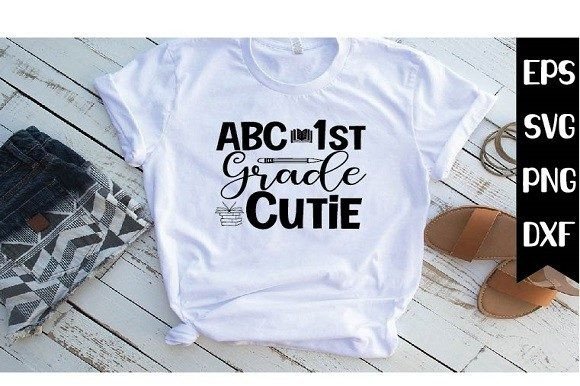
ABC 1st Grade Cutie SVG Design is a ready-to-use digital illustration file—scalable vector graphics (SVG) format—featuring playful, colourful, and age-appropriate lettering and cartoon-style elements. It typically includes uppercase and lowercase ABCs, cheerful characters (like smiling apples, friendly crayons, or chalkboard motifs), and hand-drawn calligraphy phrases such as “Welcome to 1st Grade!” or “My First Year of Big Kid Learning!” Designed with elementary education in mind, it balances preschool warmth with early-grade structure—think grunge chalk textures layered over clean typography, soft pastel palettes paired with bold outlines, and intentional whitespace for readability.
This isn’t just decoration. It’s a functional design asset that slots into real-world workflows—from classroom setup and curriculum planning to product development and brand storytelling. Its SVG format means it scales infinitely without pixelation, imports cleanly into Cricut Design Space, Silhouette Studio, Adobe Illustrator, Canva, and even basic web builders. That flexibility makes it useful across phases: pre-launch (planning signage), active implementation (printing labels or projecting welcome banners), and post-activity (archiving student work or repurposing for newsletters).
How It Fits Into Your Workflow—Before, During, and After
Before launch or setup: Teachers use ABC 1st Grade Cutie SVG Design to prototype classroom layouts digitally—overlaying the SVG onto floor plans or bulletin board mockups to test visual balance and colour harmony. Small business owners creating back-to-school merchandise (t-shirts, tote bags, stickers) import the file into print-on-demand dashboards like Printful or Gelato to preview sizing, placement, and fabric compatibility before ordering samples. Bloggers and educators building resource libraries batch-download related SVGs—including matching numbers, shapes, or emotion-themed illustrations—to maintain consistent visual language across lesson plans and social posts.
During execution: In the classroom, the SVG serves dual roles: as a teaching aid (projected on interactive whiteboards for letter-sound matching games) and as a production template (cutting vinyl for door signs, laminating labels for cubbies, or printing flashcards). For remote or hybrid learning, teachers embed static PNG exports—generated from the SVG—into Google Slides or Seesaw activities. The grunge texture and hand-lettered feel support cognitive engagement: studies show young learners retain information longer when presented with varied, low-fidelity visuals that mimic physical media like crayons or chalk.
After completion: Once a unit ends or school year wraps, the same SVG file can be re-exported at higher resolution for year-end portfolios, converted to PDF for parent handouts, or simplified into black-and-white line art for colouring sheets. Designers running creative businesses archive versions with layered naming conventions (e.g., abc_1st_grade_cutie_v3_no_background.svg) to ensure quick retrieval and version control across client projects or seasonal collections.
Integration With Tools, Teams, and Platforms
Compatibility starts with format—but extends to function. Because SVG is code-based, it works natively in HTML/CSS environments. A blogger embedding a “Welcome to Our Class!” banner on their education site can style the text with CSS filters (e.g., subtle drop shadows or hover animations) without touching the original file. Marketers using Mailchimp or Klaviyo paste SVG directly into email templates for responsive, lightweight graphics—no image hosting required.
In collaborative settings, shared cloud folders (Google Drive, Dropbox) host master SVG files alongside usage guidelines: recommended fonts for pairing (e.g., KG Primary Dots or Comic Neue), safe margins for cutting machines, and Pantone references for print consistency. When working with freelancers—say, a graphic designer refining a full back-to-school collection—the ABC 1st Grade Cutie SVG acts as the anchor asset. All supporting elements (banners, cards, class schedules) align to its baseline grid, stroke weight, and colour hex values—ensuring cohesion across physical and digital touchpoints.
For educators collaborating across grade levels, this SVG becomes part of a larger visual ecosystem. A preschool teacher might use the same character set (but simplified forms) alongside a third-grade colleague who adapts the lettering style into cursive practice sheets. That continuity supports student cognition: familiar visual cues reduce cognitive load during transitions between learning environments.
Practical Implementation Tips You Can Apply Today
- Test scalability first: Open the SVG in your preferred editor and zoom to 400%. Check for unintended stroke overlaps or jagged corners—especially around curved letters like “S” or “O”. If present, simplify paths or adjust corner radius in Illustrator before exporting for cut files.
- Separate layers intentionally: Ungroup elements (letters, icons, background textures) so you can toggle visibility. This lets you create multiple outputs from one file—e.g., a plain ABC chart for phonics drills, then add crayon icons later for a “Let’s Learn Together!” poster.
- Optimise for print vs. digital: For vinyl cutting, export as SVG with outlined strokes and flattened transparency. For web use, export as inline SVG or compressed PNG (72 dpi, sRGB). Avoid embedding fonts unless they’re web-safe or licensed for redistribution.
- Use colour strategically: The built-in palette often includes 4–6 core colours. Assign each to a purpose—e.g., blue for instructions, green for positive reinforcement phrases, yellow for attention-grabbing headers. This builds visual hierarchy students and parents recognise instantly.
- Repurpose thoughtfully: Turn the “A” icon into a reward stamp. Convert the full alphabet into an editable Google Doc table for handwriting practice. Extract the “love” or “squad” phrase for classroom job charts or peer recognition badges.
Long-Term Usability and Quality Control
Sustainability matters—not just environmentally, but workflow-wise. A well-structured ABC 1st Grade Cutie SVG Design includes named layers, non-destructive effects, and embedded metadata (creator, date, licence type). That makes it reusable across years, seasons, and platforms without degradation. Keep a master “asset log” spreadsheet tracking where each variant is used (e.g., “v2.1 – used in 2024 Welcome Banner + T-shirt Collection”), along with notes on feedback (“students responded best to purple ‘C’ during letter week”).
Consistency builds trust. When parents see the same cheerful “1st Grade Squad” motif on a classroom door, a student’s name tag, and the school newsletter, it signals intentionality—not just decoration. Likewise, small business owners leveraging this design across Etsy listings, Instagram carousels, and packaging reinforce brand identity without reinventing visuals every season.
Finally, remember that quality isn’t just about polish—it’s about purpose. The crayon texture isn’t nostalgic filler; it invites tactile interaction. The grunge edge isn’t random—it softens rigid lines for young eyes. The calligraphy isn’t just pretty; it models expressive letter formation. Every element supports cognition, inclusion, and joyful learning. That’s what makes ABC 1st Grade Cutie SVG Design more than a download—it’s a quietly powerful tool for people who plan, teach, build, and care.